Rule number 5: There’s no such thing as a perfect camera bag.
Doesn’t stop me trying though!
I’ve finally got round to reviewing the Tamrac Evolution 6 like I said I would.
Why the Evolution 6? Well, I wanted a bag big enough to carry a camera and two lenses at least, plus a few accessories. I wanted the comfort of a backpack and the ease of access of a shoulder bag, so that limited my choices to Lowepro’s Versapack or Primus, Kata’s 3-N-1 20 and Tamrac’s Evolution 6. The problem with the Primus and the 3-N-1 is that you can only access one side of the bag because of the way the internal dividers attach to the bag. I wanted to access both sides, one to get at my camera, the other to get at lenses. The only option was the Evolution.
Why haven’t I mentioned the Versapack? Well let’s just say that the Versapack is probably the worst camera bag I have ever used. I really don’t know what Lowepro were thinking when they designed that one!! (I can feel a Lowepro rant coming on, but I’ll stop there.)
I actually hesitated on the Tamrac bag for a long time, because I just didn’t like the look of it. The 3-N-1 looks great. The evolution doesn’t look great in the catalogue, but I couldn’t afford the Kata and the Tamrac bag was going for good price, so I bought it. I must say that it does look a lot nicer in the flesh than it does online. It actually didn’t take long for me to really like the bag from an aesthetic point of view. But enough about looks, how does it perform?
Features
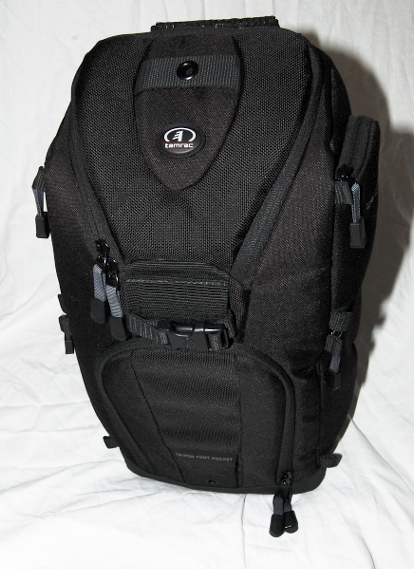 The Evolution 6 is a two compartment bag, the bottom compartment holds the camera gear, the top one holds a few extra bits and bobs, though don’t expect it to hold much. The straps can be configured allowing the backpack to be used as a backpack, left sling or right sling bag. Straps can be tucked away when not in use. There are loops for Tamrac’s strap accessory system, which to be honest, I’ve never really seen the point of. It has a front access pocket for each compartment, two side access pockets for the camera compartment and two smaller side pockets for small accessories, one of which holds a rain cover.
Comfort.
The main reason for buying the bag was comfort and after a full day in the blazing sun, it didn’t give me any bother. No aching shoulders, no discomfort, no shifting of the straps. It was just a joy to carry around. The straps are not very wide, but well padded.
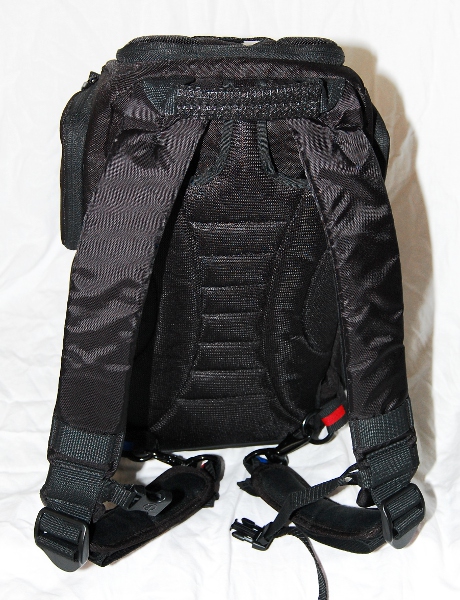 There is a sternum strap which helps during long periods of walking. There is also a waist belt which I have to admit, I tucked away and didn’t use. The bag sits quite high on the back which means I can have a waist belt with pouches without them and the bag getting in each other’s way.
Size
The Evolution 6 is a smallish bag actually, but easily fit a Nikon D90 with 18-105, a Nikon 70-300 ED, flash gun, waterproof jacket, battery, cards, lens pens, lens hoods, camera manual, and a few extra bits and bobs. The top compartment isn’t that big, so don’t expect to get a lot in there. It’s padded, so you could happily put an extra camera body or lens in it (which I did for half the day.) I had a small jacket and a couple of snacks in there as well as a lens, but more than that and you’ll struggle. If you need to carry a bit more, the Evolution 6 has a bigger brother – the Evolution 8.
Ease of Use
I used the bag as a back pack and just slid the bag off a shoulder depending on what side of the bag I needed to access. It was easy, fast and a joy to use. I didn’t have to put the bag down to get at the gear I wanted. Perfect.
One thing I was really glad to see was the number of dividers. I hate it when camera companies skimp on the internal dividers, but Tamrac gave more than enough. In fact I had to take one out of the bag for my configuration. Well done Tamrac.
Well done too for actually thinking about dual sided access. The dividers are what make this possible; they don’t attach to the sides, they attach to the edges, leaving all the available hatches available. Genius. Why no-one else has figured that out is beyond me, but kudos to Tamrac for figuring that out.
It comes with Tamrac’s tripod foot pocket and attachment strap for putting a small tripod on the back. The pocket is just about big enough for one tripod foot, so the tripod isn’t very stable – making the pocket big enough to hold two feet would have been better. Having said that, it adds a fair amount to the weight of the bag and makes the bag awkward to use, but it’s nice to have the option.
In Conclusion
Overall, it’s hard to fault the Evolution 6. Sure, the top compartment could be bigger, the tripod system could be improved and the top accessory pockets aren’t really designed to hold much, but I can’t really find much else to pick on.
I set out to find a bag that held a camera, a couple of lenses, flash and extra bits and pieces, was comfortable for a whole day of shooting and a bag that allowed me to get at my gear easily and quickly. The Evolution 6 ticks all those and then some. I give it a nine out of ten. Not perfect, but near enough.
Pics
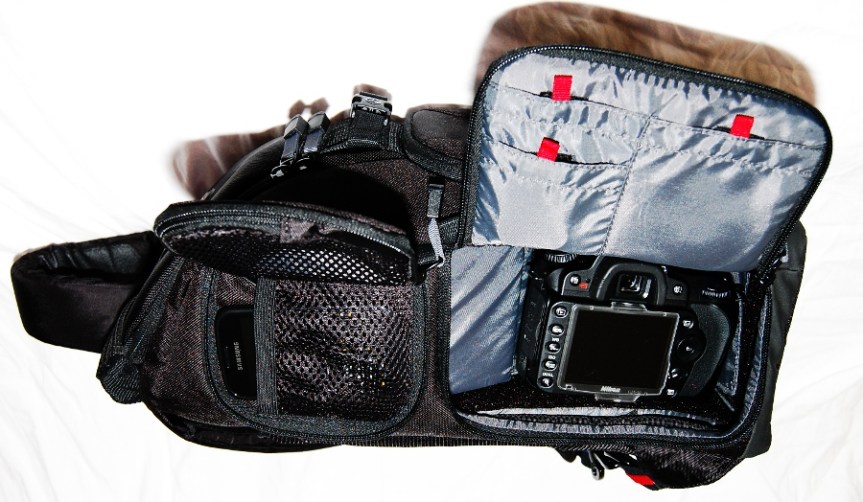 Easily fits a D90 and the camera comes out of the hatch without a struggle. The top pocket fits a mobile.
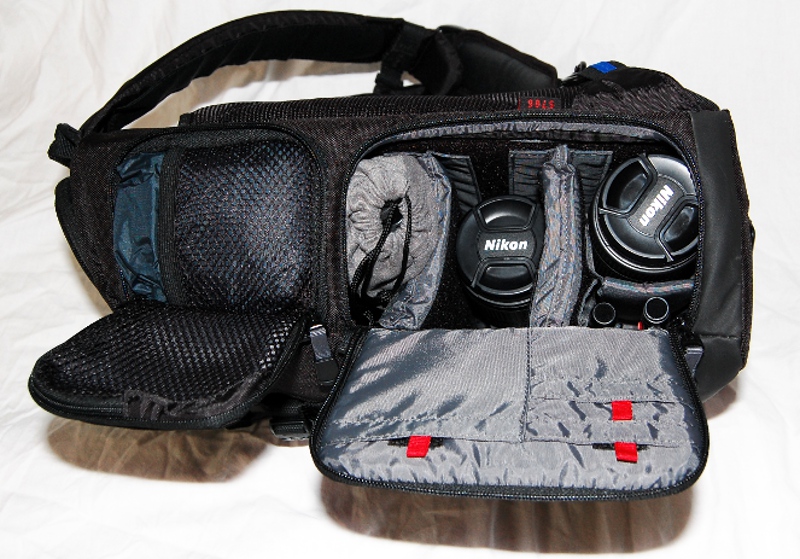 The other side showing the 18-105 attached to the D90. On either side is a Nissin Di622 flash and a Nikon 70-300ED and a couple of lens pens.
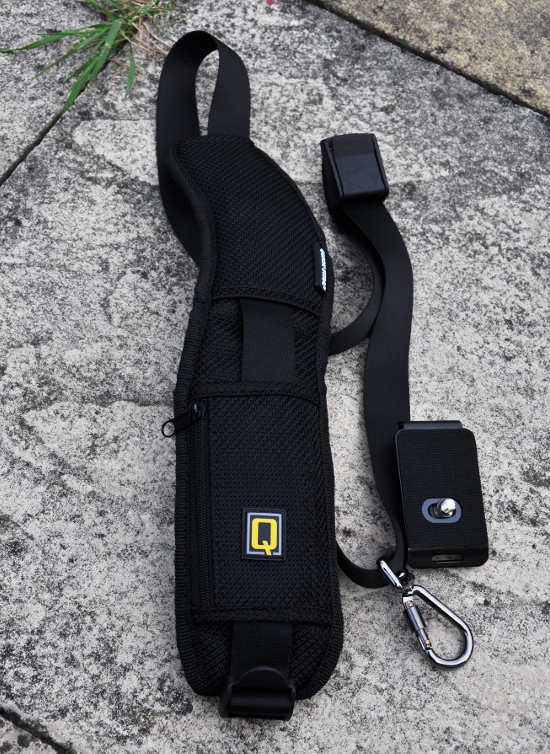
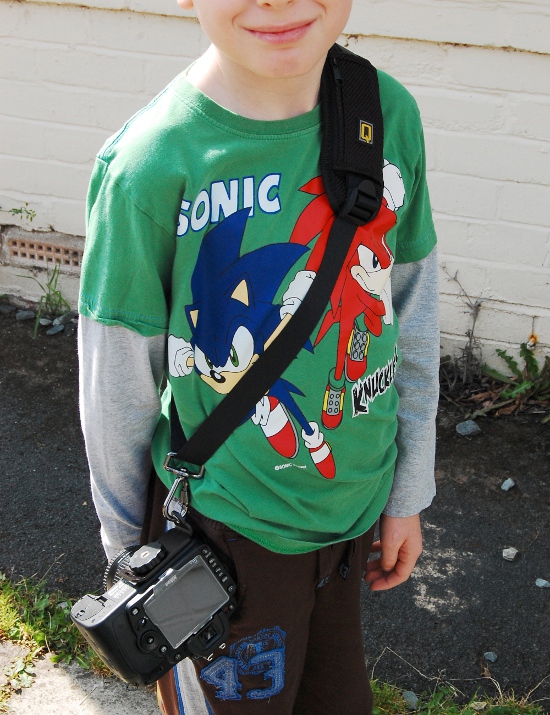
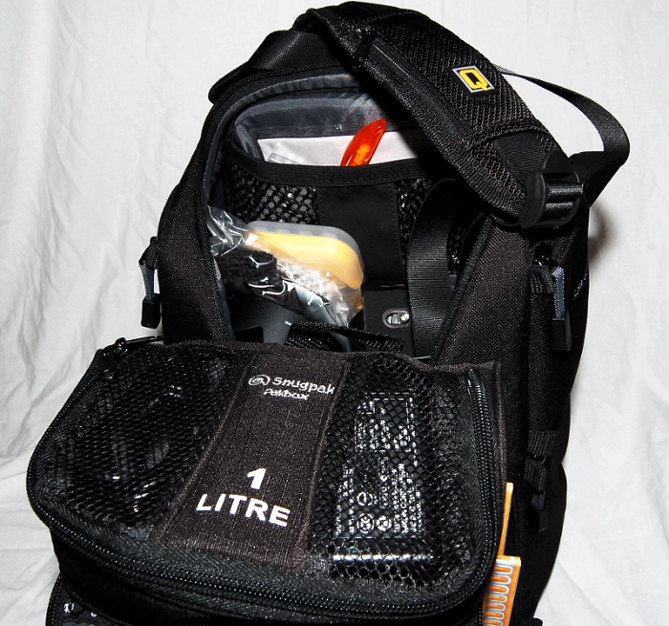 What I keep in the top compartment: a 1ltr snugpack holding charger, remote release and cables, batteries for camera and flash, lens hoods, quick strap (imitation black rapid) including attachment plate, pen, soft box for the flash, cloth, lens cap and body cap. It’s a tight squeeze, but it all fits.


 WeavingLight