
Favourite Locations: Fountains Abbey

Fountains Abbey, North Yorkshire

Everyone has a style of photography that suits them, or subjects that they love to shoot time after time. For me, I love ruins. Ruins provide a plethora of shapes, textures and a fair bit of play between shadow and light. I’m very fortunate to live not too far from some spectacular Abbey’s, of which Fountains Abbey is my absolute favourite.
I’ve only been to Fountains twice, but now that I find it on my doorstep, I have the luxury of being able to go back more often.
My first visit was back when I was shooting film, and insanely carrying around a full 35mm setup and a Pentax 645 setup. (How my back coped with that I’ll never know.) By this time, I was shooting monochrome as part of a college course and was well on the way to ditching colour film. It was also the first real time shooting medium format and an excuse to try two new films – Fuji Acros 100 and Ilford Delta 100.
Fountains Abbey sits in a large estate with a variety of gardens and structures, yet I never ventured far from the Abbey itself. The stand out feature of Fountains is the Cellarium, a large vaulted chamber that is remarkably complete and awe inspiring. I set up my tripod and spent about half an hour taking shots, changing lenses and taking more shots. It was almost surreal standing there. I chose a side of the Cellarium that had a cross located at the end and it seemed that no one else had noticed it as people were taking photos elsewhere. It gave me an unobstructed view and plenty of time.
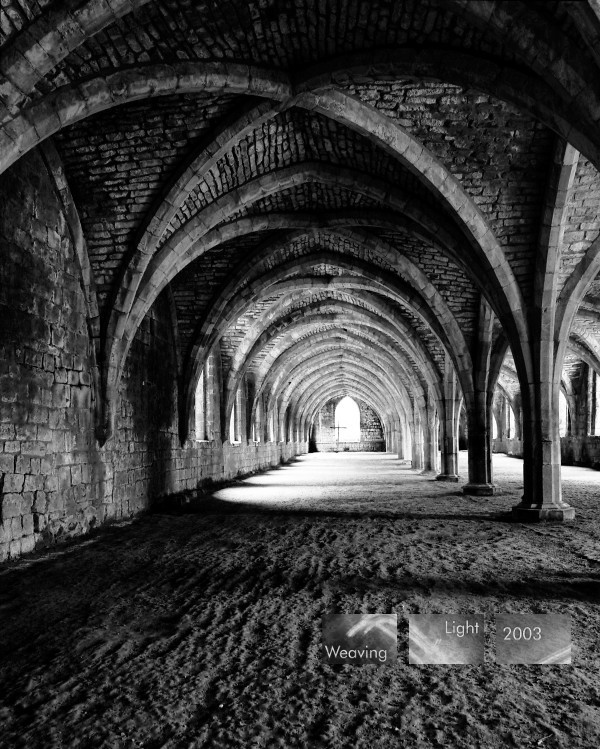
The Cellarium Fountains Abbey
The Cellarium at Fountains Abbey

The stand out shot was taken on Fuji Acros with a Pentax 645. It is the only negative I printed to 16 x 20 and kept – it still hangs in the living room, spoiled only by a streak where the fixer has started to turn brown. The detail captured by the negative is staggering; you don’t really get the full impact of that from the scan.
Several years later, we moved closer to Fountains and we took a family trip. This time I was shooting digital and had far less gear to carry around, but again, I was drawn to the Cellarium. No tripod and four kids running around, the atmosphere was totally different, and so was the way I made the shots. ISO 800 with a Nikon 18-105 DX lens and hand held, plus shooting in colour.
I decided to try and get more of the Cellarium into the shot and tried to get the kids in there as well. There was one stand out image and that was the one below. My youngest son was overjoyed to be out of the pushchair and running around. The presence of the toddler and his wandering toward the cross lend the image an atmosphere that is missing from the first image.
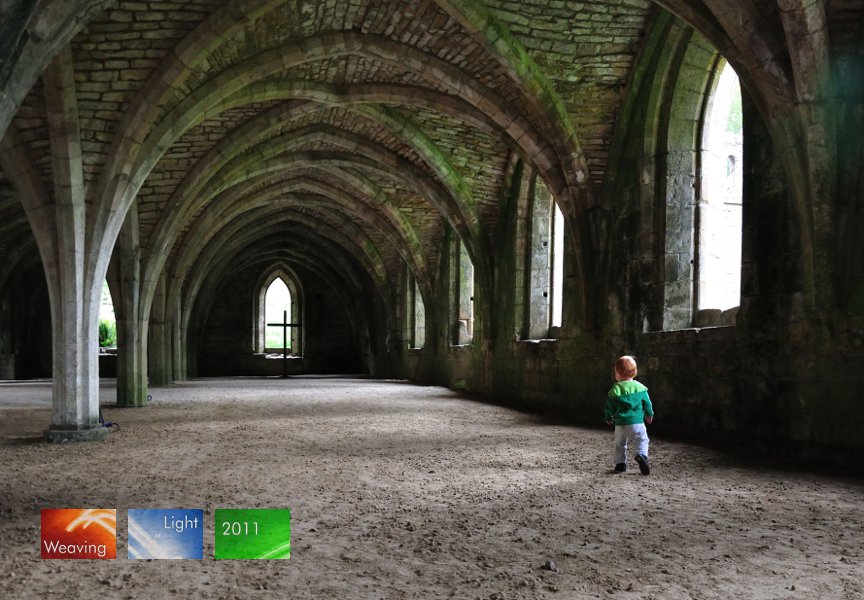
The Cellarium Fountains Abbey
A different time and a different view of the Cellarium

That said, neither really captures the full impact of standing there. A third visit is definitely on the cards and an opportunity to try capture the place in yet another way.


Long Live Film. Long Live Digital

Thinking about film got me thinking about the old film vs digital debates that have gone on over the last few years. I’ve never seen it as a vs situation.
There are things I like about both formats. With film, I hit a comfort zone. I was good at black and white. I could see in monochrome and that worked for me. I experimented with a few films and found my favourites; the ones that gave me the kind of results I liked. I found a groove and stuck with it. I also liked the fact that I knew my camera would last. I had Nikon F100 with an F80 as backup and they were great cameras. I also had an F301 manual focus camera which I still have. It’s about 25 years old now and still working fine. Can’t imagine saying that about my D90 25 years from now.
Digital feels like starting over for me. Gone is the safety net of knowing how the image will look on a certain type of film. Gone is the skill of using a certain type of film to get a certain type of result. Now I have to deal with colour and white balance and stuff. Yet, with it comes a certain freedom that I’m really enjoying. I can afford to be creative, to experiment, to play and not have to worry about wasting film. I can see instantly if the composition worked, or if I missed something, or something might inspire me to do it differently while looking at the LCD. I may have lost some of the discipline I gained as a film photographer, but that freedom to play has brought a new sense of enjoyment to my photography. (The images used for my blog banner are a great example of this. Just messing around and looking at the patterns on the LCD. Could never have done that with film.)
Plus, with digital photography comes a new set of skills. The skills of the darkroom are now replaced with the skills of the lightroom, and best of all, I don’t have to worry about dust like I used to. (Anyone remember having a perfect print ruined by a spec of dust on the negative?)
I still have a soft spot for film; always will and I hope I can keep dipping into film photography for many more years. But digital has given me a new photographic lease of life and a renewed enthusiasm for the craft. So long live film and long live digital.

The Second Death of Film

Part whatever…

I read this week that Kodak are struggling to make ends meet. In some ways, this isn’t even news. Kodak’s star has been growing dim for a long time, even before digital. (It’s ironic since Kodak were one of the major players in the very dawn of digital imaging.)

The real shame for me is the fact that my favourite films are Kodak emulsions. Tmax 100, 400 and especially 3200 are superb films and though personal preferences play a part in a photographers choice of film, for me, there isn’t another film that matches the punch you get with Tmax. There certainly isn’t another film like the 3200 speed Tmax, a nice mixture of punchy contrast, nice tones and a lovely grain that the closest rivals can only dream of.

tmax 3200 portrait
low light protrait with Tmax 3200. It looks soft on the monitor thanks to the lovely grain.

Should these emulsions be lost to the annuls of history, it will be a loss to future generations of photographers who will have to rely on software such as DXO labs film pack (which I have to say, does a pretty nice job of recreating the Tmax 3200 look) or look to Ilford Delta 3200, which, for me, lacks the punch of the Kodak film.

portrait processed with DXO film pack
Digital file processed with DXO film pack to recreate the Tmax 3200 feel. Not a bad recreation.

That said, it may be the Ilford model which saves the Kodak emulsions. It wasn’t so long ago that Ilford were in dire straights themselves. The solution, split the business in two. The film business remains as Ilford and keeps their film emulsions alive for future generations. Agfa went through the same pain.

Will the death of Kodak mean the death of film, yet again? Not likely. Film, though no longer the mainstream choice for photographers, still has a following and there are some mighty fine monochrome emulsions coming Eastern Europe from the likes of Foma and Rollei, and we still have Kodak and Fuji (for the moment), but the old guard cannot keep going with the same model and there is a risk that we may lose some of our favourite film emulsions along the way. Let’s face it, we’ve already lost a few.

It really would be a shame to lose Kodak. So take the challenge. If you have a film camera, buy a roll of film and relive the challenge of shooting with film. If you have never shot film, go buy a cheap camera, there are loads about, and experience the thrill of not knowing if you bagged the shot until the prints come back. Most of all, enjoy the challenge of spreading your photographic wings.

Film aint dead. Long live film.

PS: if you’re in the UK, a great place to start is Silverprint. They have a big range of films, unusual cameras and all sorts of good stuff. they’re friendly too.